What Is Baklava? The Crispy, Nutty Classic
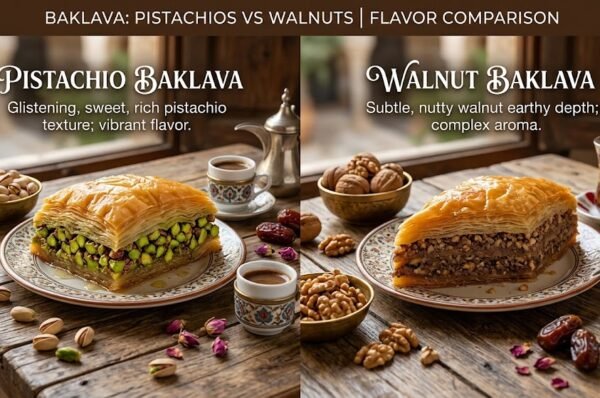
Baklava vs kunafa starts with understanding what baklava actually is. Baklava is a pastry built entirely from dozens of paper-thin phyllo (filo) dough sheets, each brushed with clarified butter or ghee, layered over a filling of finely chopped roasted nuts — pistachios, walnuts, or cashews being the most traditional choices. The assembled tray is baked at high heat until every layer turns golden and audibly crispy, then immediately soaked in sugar syrup scented with lemon juice or rose water.
The result is a dessert of extraordinary precision. Every bite cracks through the layered pastry before releasing the dense, buttery, roasted nut filling underneath. Baklava is most commonly cut into diamond or square shapes — the classic presentation that reveals its multiple layers — though you will also find it formed into rolls called assabeh (fingers), triangles, or small round tarts depending on regional tradition.
Baklava’s roots stretch back nearly 3,000 years. According to food historians at Oxford Academic, early versions of layered nut-and-honey pastry appeared in the Assyrian Empire, though the refined phyllo-based form is most strongly associated with the Ottoman imperial kitchens of the 15th century. Turkey, Greece, Syria, Lebanon, and Armenia all produce distinct regional versions — and each is genuinely different in syrup intensity, nut selection, and pastry thickness.
At Damas Sweets, our baklava follows the Syrian tradition — lighter on syrup, more balanced in its nut-to-pastry ratio, and made with premium Aleppo pistachios. Browse the full selection at our baklava collection.
What Is Kunafa? The Warm, Stretchy Showstopper
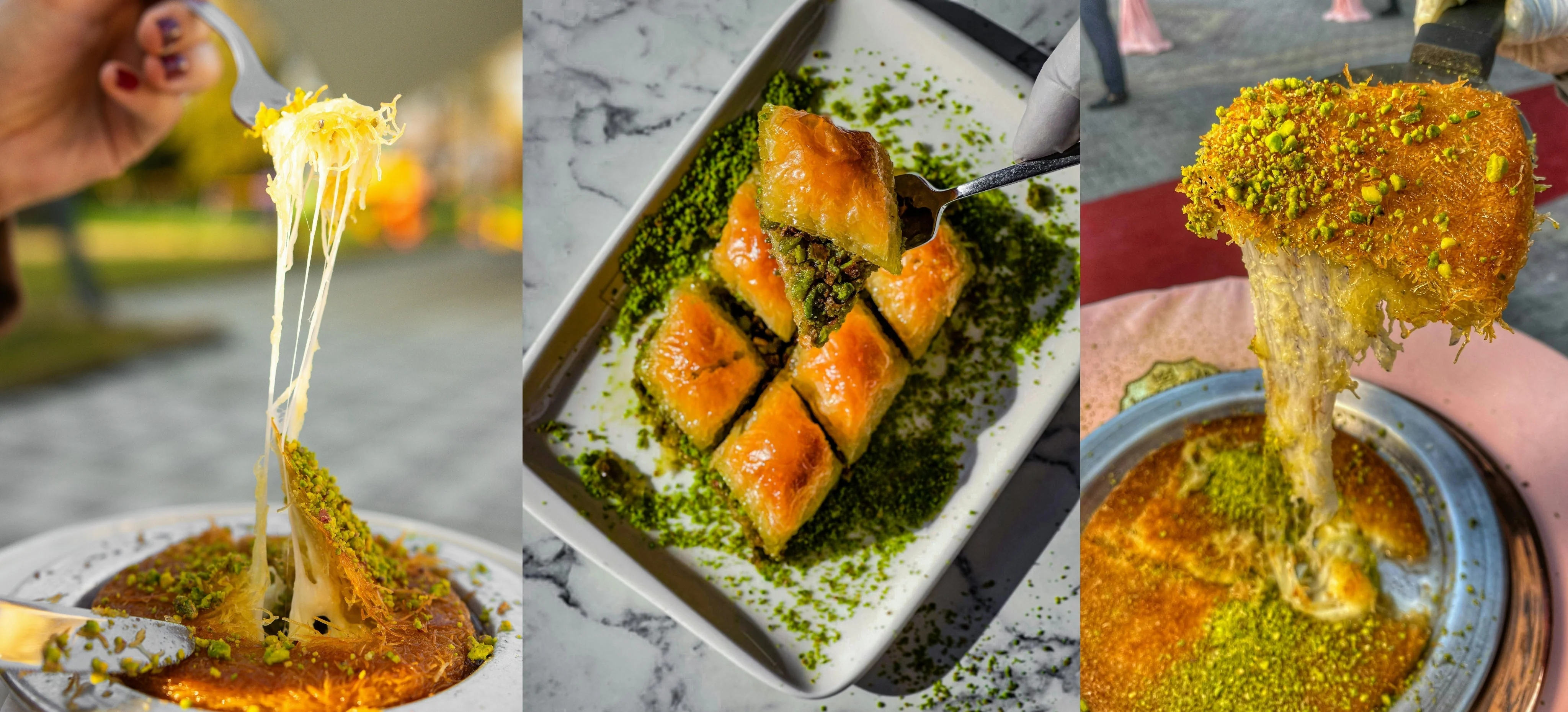
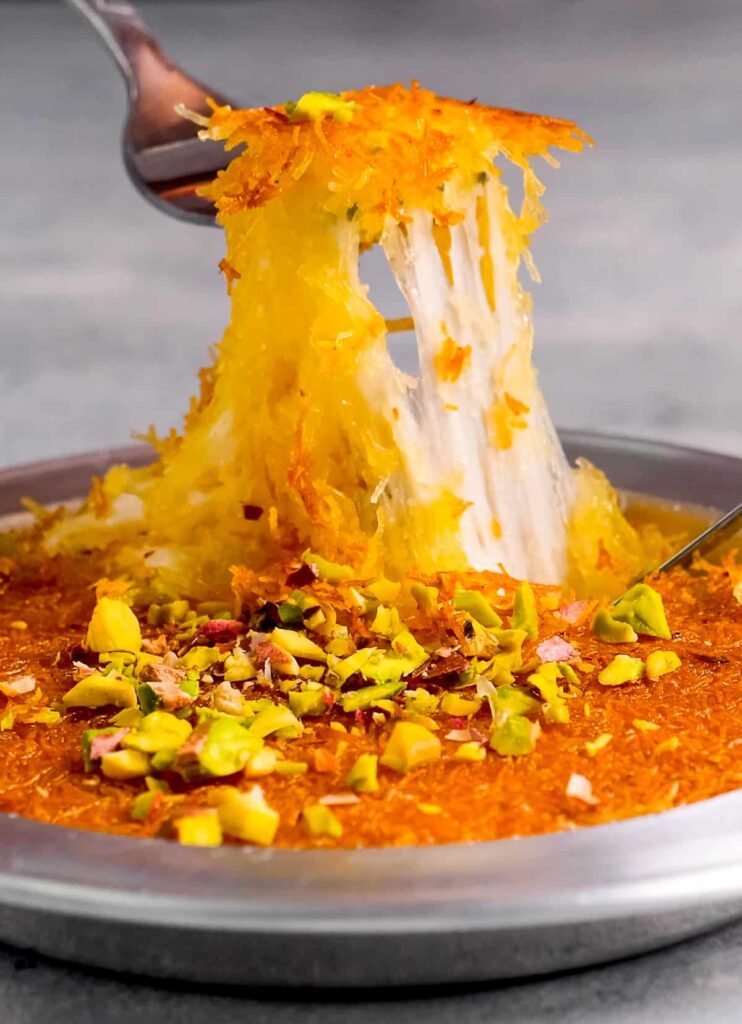
When comparing baklava vs kunafa, the second half of the equation is equally important. Kunafa (spelled also as knafeh, kanafeh, or künefe) uses no phyllo sheets whatsoever. Instead, it is built from kataifi dough — extremely fine, thread-like wheat strands that look like shredded wheat or thin vermicelli. These strands are packed into a buttered baking tray, a soft filling is placed in the middle, then another layer of kataifi is pressed on top. The tray bakes until the exterior turns a rich amber gold.
The filling transforms the dessert entirely. Traditional kunafa uses akkawi cheese — a white, lightly salted fresh cheese from the Levant — soaked overnight in water to reduce its saltiness, then often blended with mozzarella for extra stretch. Some versions use ashta (clotted cream) or a thick custard instead. The moment the kunafa exits the oven, it is flipped onto a serving tray, soaked in rose water–scented sugar syrup, and finished with a generous layer of crushed green pistachios.
Kunafa is primarily a Palestinian and Syrian dessert by heritage. The Palestinian city of Nablus holds such a strong historical claim to the dessert that of Nabulsi kunafa as an authentic product of the region.
Discover Damas Sweets’ fresh kunafa range at our kunafa pastry page, and for a deep dive into kunafa’s ingredients and types, read our complete kunafa guide.
Baklava vs Kunafa: Full Comparison Table
Baklava vs Kunafa: 7 Mistakes Malaysians Make When Choosing
Understanding baklava vs kunafa goes beyond knowing the ingredients — the real gap is in the decision-making. Here are the seven most common mistakes Malaysians make when choosing between the two, and how to avoid every single one.
Mistake 1: Ordering kunafa for a gift box.
In any baklava vs kunafa gifting situation, baklava wins without question. Kunafa must be eaten fresh and warm; it loses its texture completely within hours. Baklava stays fresh for up to 14 days at room temperature. If you are building a hantaran set, an Eid hamper, or a corporate gift, always choose baklava.
Mistake 2: Expecting kunafa to taste like baklava.
The baklava vs kunafa taste comparison is not a matter of one being better — they are designed for completely different experiences. Expecting kunafa to be nutty and crispy like baklava will leave you disappointed. Kunafa is warm, stretchy, and savoury-sweet. Baklava is room-temperature, crunchy, and richly sweet. Know which experience you are seeking before you order.
Mistake 3: Choosing baklava for a warm dessert occasion.
When a gathering calls for a warm, impressive centrepiece dessert, the baklava vs kunafa answer is clear: kunafa. A freshly baked kunafa tray, still steaming with melted cheese and fragrant with rose water, creates a moment that no box of baklava can replicate. Baklava is for gifting; kunafa is for occasions.
Mistake 4: Buying packaged versions without checking halal status.
In the baklava vs kunafa packaged product market, both desserts can contain non-halal gelatin or alcohol-based flavouring agents added by commercial manufacturers. Always verify JAKIM halal certification before purchasing any packaged version from a supermarket or online marketplace.
Mistake 5: Refrigerating kunafa and expecting it to taste the same.
Unlike the baklava vs kunafa storage comparison where baklava clearly dominates, many people refrigerate leftover kunafa expecting to enjoy it the next day at the same quality. Refrigerated kunafa firms up, loses its stretch, and the kataifi crust softens unevenly. Always order kunafa only in the quantity you plan to eat the same day.
Mistake 6: Assuming all baklava varieties taste the same.
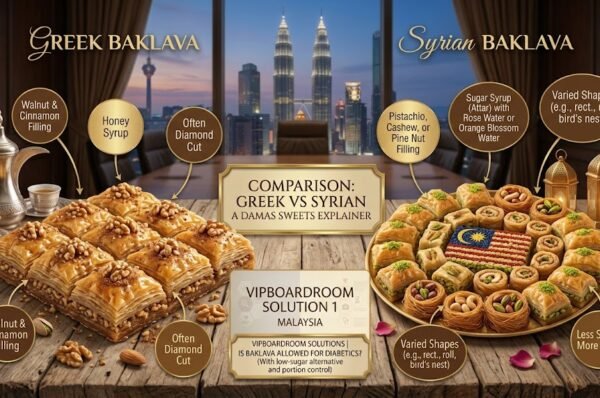
The baklava vs kunafa conversation often treats baklava as a single dessert. In reality, pistachio baklava, cashew baklava, walnut baklava, and mixed nut baklava are genuinely different taste experiences. Syrian-style baklava, Turkish-style baklava, and Lebanese-style baklava differ in syrup intensity, pastry thickness, and nut selection. Ask your supplier which style they follow — it matters enormously. At Damas Sweets, all baklava follows the traditional Syrian recipe. Explore our full baklava range to see the varieties available.
Mistake 7: Trying to make a definitive choice without tasting both.
The ultimate answer to baklava vs kunafa is that neither is better — they are different. The only real mistake is choosing one permanently without experiencing the other. If you have only tried baklava, order kunafa next. If you have only tried kunafa, a premium pistachio baklava will surprise you. Both are available at Damas Sweets, and our team at both Ampang and Serdang outlets will happily help you explore both. Visit our full menu to start.
Baklava vs Kunafa: Taste — An Honest Description
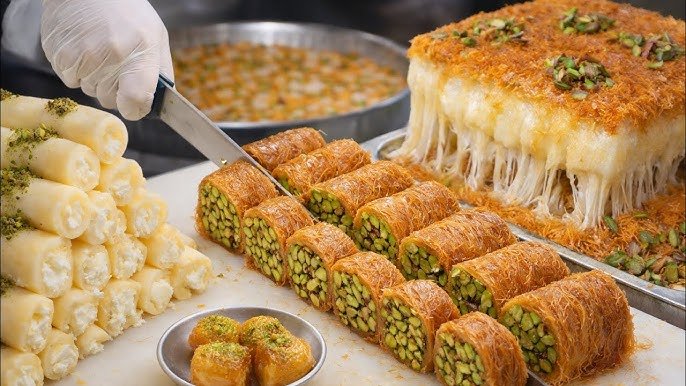
The baklava vs kunafa taste comparison is where most people form their strong preference. Understanding both experiences before you choose matters.
Baklava delivers a structured, layered eating experience. The pastry shatters on the first bite, releasing a rush of buttery layers and dense, fragrant nut filling. The sweetness is front and centre — prominent, rich, and satisfying. The slight bitterness of roasted pistachio cuts through it cleanly. The syrup binds everything together without making the pastry soggy. Baklava is a dessert that rewards patience — it tastes better eaten slowly, piece by piece.
Kunafa is a warmer, more theatrical experience. The outer crust gives a gentle crunch that gives way immediately to the stretchy, warm cheese filling pulling apart in strands. The rose water syrup floods through the layers in waves. The cheese adds a quiet savoury note — not overwhelming, but distinctly present — that prevents the sweetness from being monotonous. The crushed pistachios add a final earthy contrast. Kunafa is not eaten; it is experienced.
Most food writers agree on this contrast. As noted in multiple culinary reviews, baklava is precision and restraint; kunafa is warmth and drama. Neither is better — they are answers to different questions.
Sweetness Level: Which Is More Intense?
In any baklava vs kunafa comparison, sweetness is one of the most deciding factors — especially for Malaysian palates that are not always accustomed to the intensity of Middle Eastern sugar levels.
Baklava is consistently the sweeter of the two. The sugar syrup penetrates all the phyllo layers and soaks into the nut filling, creating a unified sweetness throughout. There is no savoury element to moderate it. This is why baklava pairs so naturally with unsweetened Arabic coffee (qahwa) or plain tea — the bitterness of the drink cuts through and refreshes the palate between pieces.
Kunafa’s sweetness is moderated by the akkawi cheese. The cheese introduces a gentle saltiness and a creamy, savoury richness that acts as a natural counterbalance to the syrup. Many people who find baklava slightly too sweet discover that kunafa is more approachable. This makes kunafa a particularly good entry point for people who are curious about Middle Eastern desserts but cautious about sugar intensity.
Are Both Halal? What to Check in Malaysia
Both baklava and kunafa are halal in their traditional form. The ingredients — phyllo or kataifi dough, nuts, white cheese, butter, and sugar syrup — contain no pork derivatives, gelatin, or alcohol.
The risk arises with commercial and packaged products. Some mass-produced baklava sold in supermarkets uses pork-derived gelatin as a stabiliser in the packaging or glaze. Some ready-to-heat kunafa kits include flavouring agents with alcohol bases. These are not always obvious on the label.
All baklava and kunafa at Damas Sweets carry full halal certification. Our products follow traditional recipes with no non-halal additives. For more on what to look for when choosing halal Arabic sweets in Malaysia, visit our halal sweets guide.
Storage and Shelf Life: A Critical Practical Difference
The baklava vs kunafa storage difference is the most important practical consideration — particularly for gifting, events, and bulk orders.
Baklava is an excellent keeper. Stored in an airtight container at room temperature, away from heat and sunlight, quality baklava stays fresh for 10 to 14 days. The sugar syrup acts as a natural preservative, and the dried nut filling is inherently stable. This makes baklava the overwhelmingly preferred choice for Eid gift boxes, hantaran sets, corporate hampers, and any situation where the dessert needs to be prepared ahead of time, shipped, or received on a different day. Our premium gift boxes are designed around this exact quality.
Kunafa is a same-day dessert. Its quality begins to drop within hours of baking. As the kunafa cools, the cheese filling firms and loses its stretch, the kataifi crust softens and absorbs excess syrup unevenly, and the textural contrast that defines the dessert disappears. You can refrigerate kunafa for one to two days and reheat it in an oven — but the experience will not replicate fresh-baked kunafa. For this reason, kunafa should be ordered for same-day consumption at gatherings, iftar tables, or family occasions.
Which Should You Choose? The Final Verdict
The baklava vs kunafa decision ultimately comes down to one question: what is the occasion?
Choose baklava when you need a dessert that travels, stores, impresses at first sight, and works as a gift. Baklava is the gift that keeps. It arrives in perfect condition, looks beautiful in a box, and can be eaten across several days. It is the right choice for Eid, hantaran, corporate gifts, and any occasion where presentation and practicality both matter.
Choose kunafa when you want a warm, communal, memorable dessert experience at a gathering. Kunafa at a table — fresh, steaming, golden, with melted cheese pulling from the tray — creates a moment that no box of baklava can replicate. It is the dessert that makes people stop talking and start eating.
If you are choosing for the very first time, try baklava. The experience is immediately accessible, the quality is easy to evaluate, and the variety available means there is a version for every preference. Then, at your next occasion, order kunafa — and experience what changes.
Both are available at Damas Sweets in Ampang and Serdang, with delivery across Malaysia. Visit damassweets.com for the full menu and online ordering.
Frequently Asked Questions
Is baklava the same as kunafa?
No. Baklava and kunafa are completely different desserts. Baklava uses layered phyllo sheets filled with chopped nuts. Kunafa uses kataifi noodle strands filled with white cheese or cream. The only similarities are their Middle Eastern origin and the use of sugar syrup. The dough, filling, texture, taste, and serving temperature are all different.
Which is sweeter — baklava or kunafa?
Baklava is sweeter. Kunafa is moderated by the savoury note of the akkawi cheese filling, which balances the sugar syrup. Many people who find baklava too sweet prefer kunafa.
Is kunafa halal in Malaysia?
Yes, kunafa made with traditional ingredients — kataifi dough, white cheese, butter, and sugar syrup — is halal. When buying commercial or packaged kunafa, check for JAKIM halal certification to ensure no non-halal additives are present.
How long does baklava last?
Baklava stored in an airtight container at room temperature stays fresh for 10 to 14 days. It does not need refrigeration. This is one of the main reasons baklava is preferred for gifting.
Can kunafa be stored in the fridge?
Yes, but only for one to two days. Refrigerated kunafa should be reheated in an oven before eating. The texture after refrigeration will not be as good as fresh-baked kunafa.
Where can I buy authentic baklava and kunafa in Kuala Lumpur?
Damas Sweets has outlets in Ampang and Serdang, with online ordering and delivery available across the Klang Valley and major Malaysian cities. Visit damassweets.com to browse the full menu.