Baklava vs kunafa Malaysia — it is the most debated Arabic dessert question in the country in 2026, and every Malaysian who has tasted both understands exactly why the debate is so passionate.
Baklava vs kunafa Malaysia is not a simple comparison of two similar products. These are two fundamentally different Arabic dessert experiences — different in texture, temperature, history, occasion, nutritional profile, and the specific sensory memory they create for every person who encounters them for the first time. This guide settles the baklava vs kunafa Malaysia question completely — with the full historical context, the precise technical differences, the nutritional comparison, the perfect occasion guide for each, and exactly where Malaysians can order both at the authentic Old Damascus standard in 2026 from Damas Sweets.
Baklava vs Kunafa Malaysia: Why This Question Matters More Than Ever in 2026
The baklava vs kunafa Malaysia question has become genuinely important in 2026 because both products are now widely available in the Malaysian market — and the quality gap between authentic and commercial versions of each is as wide as it has ever been.
Malaysian buyers discovering Arabic sweets for the first time face a specific problem: the baklava vs kunafa Malaysia decision is being made on delivery app listings where both products look approximately equal, and the only way to know which experience is right for a specific person, occasion, or recipient is to understand what each product actually is at its authentic best. Ordering the wrong one for the wrong occasion — or ordering a commercial version of either — produces an experience that does not represent what the baklava vs kunafa Malaysia comparison actually offers at its authentic standard.
This guide changes that completely. By the end, the baklava vs kunafa Malaysia decision will be clear, well-informed, and confident for every occasion — and the authentic standard of both will be unmistakable.
What Is Baklava? The Foundation of the Baklava vs Kunafa Malaysia Comparison
Before the baklava vs kunafa Malaysia comparison can be made with precision, each product must be understood at its authentic best — beginning with baklava.
Authentic baklava is a cold, crispy, layered pastry dessert built from a minimum of 40 ultra-thin sheets of phyllo dough, each rolled to near-translucency and separated by pure clarified butter — ghee. The filling is finely ground or chopped premium nuts — most authentically imported Aleppo pistachios from northern Syria — applied in the specific ratio defined by the Old Damascus recipe tradition. The product is baked to deep golden perfection in a stone oven and finished with natural blossom syrup — orange blossom and rose water in the Damascene ratio that enhances the pistachio flavour without overpowering it.
The authentic baklava experience in the baklava vs kunafa Malaysia comparison is defined by four sensory signatures: the warm golden ghee aroma that fills the room within one second of opening the box, the vivid natural green of Aleppo pistachio filling visible before the first bite, the audible crack of 40+ phyllo layers on that first bite, and the clean balanced sweetness that follows. Baklava is elegant, structured, crisp, and refined — a product that reveals its quality to every sense before it reaches the palate.
What Is Kunafa? The Second Half of the Baklava vs Kunafa Malaysia Comparison
The second half of the baklava vs kunafa Malaysia comparison is a product that is the direct sensory opposite of baklava in almost every respect — and equally extraordinary at its authentic best.
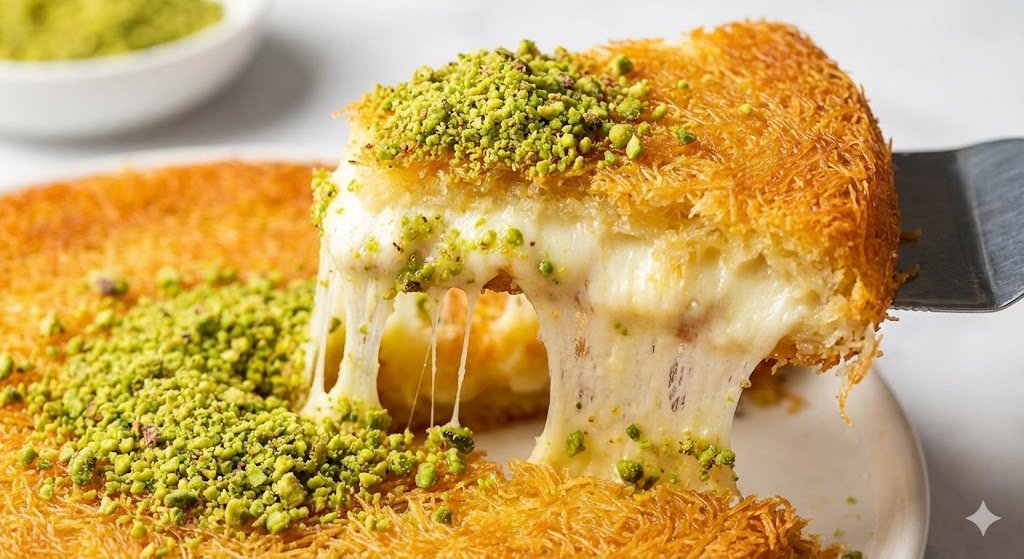
Authentic kunafa — also written kanafeh or knafeh — is a warm, soft, layered dessert built from kataifi (spun shredded pastry dough) or fine semolina, filled with stretchy cheese (most authentically Nabulsi or mozzarella) or cream, baked to golden crispness on the exterior, and finished with natural blossom syrup and crushed Aleppo pistachios on top. The product is served warm — always warm — and the defining experience is the dramatic stretch of the melted cheese filling when the first piece is lifted, and the contrast between the crispy golden exterior and the soft, gooey, fragrant interior.
Kunafa originated in the Levant — with its most celebrated variant, Knafeh Nabulseyeh, tracing its heritage to the Palestinian city of Nablus. It became a central Ramadan dessert across the Arab world, traditionally prepared in large circular pans and shared at communal iftaar gatherings — a dessert of abundance, warmth, and generosity. In the baklava vs kunafa Malaysia comparison, kunafa is described as “cozy and soulful” where baklava is “elegant and structured.”
Why “Baklava vs Kunafa Malaysia” Deserves Its Own Answer
The baklava vs kunafa Malaysia question has a specific answer that is different from the global comparison — because the Malaysian context adds dimensions of occasion, gifting culture, climate, and Halal standards that are unique to this market.
In Malaysia’s tropical climate, baklava’s room-temperature storage requirement and 20 to 30-day shelf life make it the natural choice for the gifting culture that defines Malaysian social occasions — Raya boxes, corporate hampers, wedding doorgifts, and cross-city deliveries that need to arrive intact and at peak quality after transit. Kunafa, by contrast, is a fresh, warm, serve-immediately product whose experience depends entirely on being consumed within minutes of reheating — making it the perfect choice for home gatherings, office celebrations, and any occasion where the dessert is being served rather than gifted.
The baklava vs kunafa Malaysia Halal consideration is identical — both are 100% Halal certified at Damas Sweets, with no pork, no alcohol-based flavourings, and no non-Halal ingredients at any stage of production. Both carry the full Damas Sweets Halal guarantee that every Malaysian Muslim buyer requires. In the baklava vs kunafa Malaysia comparison, Halal compliance is not a differentiator — it is a given.
Baklava vs Kunafa Malaysia: The Complete Technical Comparison
The baklava vs kunafa Malaysia difference is most clearly understood through a direct, precise comparison across every dimension that defines each product.
Texture and Temperature
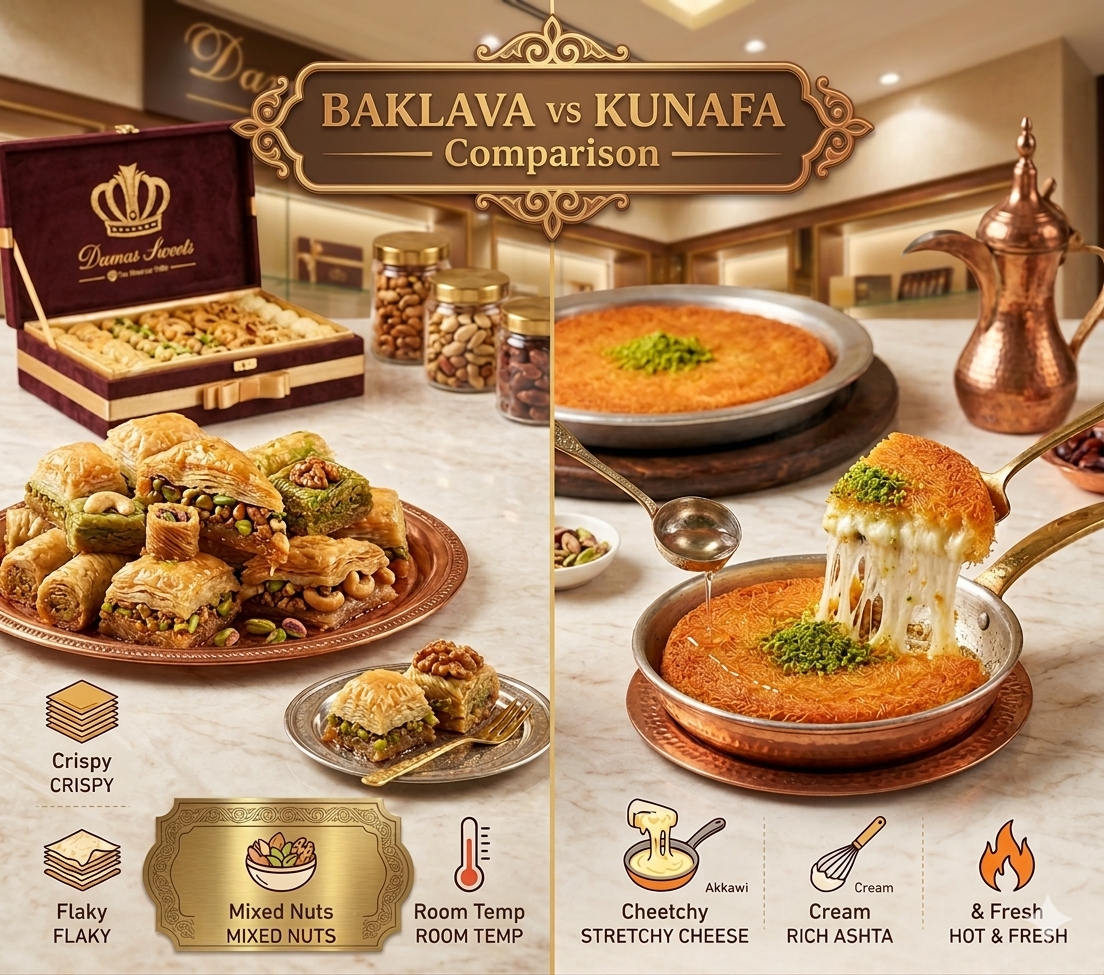
Baklava is cold and crispy — served at room temperature, with a structural crunch that is the product’s primary physical signature. The 40+ ultra-thin phyllo layers, perfectly separated by pure ghee and baked to the precise golden point, produce a crunch that is audible, deeply satisfying, and consistent from the first piece to the last. Kunafa is warm and soft — served hot from the oven or reheated, with a crispy golden exterior that gives way immediately to a soft, gooey, stretchy cheese or cream filling. The experience is one of warmth, comfort, and richness that is the direct sensory counterpart to baklava’s crispness.
In the baklava vs kunafa Malaysia comparison, neither texture is superior — they serve entirely different emotional and sensory purposes, and the right choice depends entirely on the occasion and the recipient.
Pastry Structure
Baklava uses phyllo dough — ultra-thin flat sheets stacked in layers of 40 or more, with ghee applied at every individual layer during production. The stack is cut into diamond, square, or roll shapes before baking, producing individual pieces that are complete and self-contained. Kunafa uses kataifi — fine, string-like shredded pastry dough that is pressed into a pan, filled, covered, and baked as a single unit before being portioned. The kataifi strands, coated in pure ghee and baked to golden crispness, produce a fundamentally different texture from phyllo — looser, more open, and with a specific toasted flavour that the flat phyllo sheet does not produce.
Filling
Baklava is nut-filled — most authentically with imported Aleppo pistachios, but also with walnuts, cashews, or cream depending on the variety. The nuts provide the structural core of each piece and the primary flavour driver alongside the blossom syrup. Kunafa is cheese or cream-filled — with the Damas Sweets Cheese Kunafa using Halal-certified mozzarella that stretches dramatically when lifted. The cheese provides the dominant flavour and texture experience of kunafa — warm, savoury-sweet, and deeply comforting in a way that the nut-filled baklava experience is not designed to be.
Serving and Storage
Baklava is served at room temperature with no heating required, stored in an airtight container away from sunlight, and maintains full quality for up to 30 days. This makes it the perfect gifting product — it travels, it stores, and it delivers its full experience without any preparation by the recipient. Kunafa is served warm — reheated at 180°C in an air fryer for 4 to 5 minutes before serving — and consumed within 3 days of production. This makes it the perfect gather-and-serve product — it is the dessert that creates a moment, not a gift that travels.
Nutritional Profile
In the baklava vs kunafa Malaysia nutritional comparison, both products offer genuine benefits from their core ingredients. Baklava delivers the proven cardiovascular, antioxidant, and metabolic benefits of Aleppo pistachios — including heart-healthy monounsaturated fats, antioxidants lutein and zeaxanthin, vitamin B6, potassium, and dietary fibre — alongside the fat-soluble vitamins A, D, E, and K from pure ghee. According to research published by Healthline, pistachios are among the most nutritionally complete nuts available, with proven benefits for cardiovascular health, blood sugar regulation, and gut health from their fibre content.
Kunafa delivers the nutritional benefits of Halal-certified dairy — protein, calcium, and phosphorus from mozzarella, alongside the same pure ghee fat-soluble vitamin profile. Both products are best consumed as part of a balanced diet — 1 to 2 baklava pieces or one serving of kunafa — paired with Arabic coffee or cardamom tea for optimal satiety. The baklava vs kunafa Malaysia nutritional comparison does not produce a clear winner — both deliver genuine nutritional value from high-quality ingredients when produced to the authentic standard.
Baklava vs Kunafa Malaysia: The Direct Comparison Table
Baklava vs Kunafa Malaysia: The Occasion Guide
The baklava vs kunafa Malaysia decision becomes straightforward the moment the occasion is identified — because each product is perfectly engineered for a specific set of circumstances.
Choose Baklava When:
Baklava is the choice in the baklava vs kunafa Malaysia decision whenever the primary purpose is gifting, transporting, or providing a lasting food experience that the recipient controls the timing of. Raya gift boxes, corporate hampers, wedding doorgifts, cross-city deliveries, and long-distance gifts to family in Sabah, Sarawak, or any other state — baklava is the correct answer every time. It travels beautifully, it stores for 30 days under correct conditions, and it delivers its full experience without any preparation, heating, or timing requirement from the recipient. The Damas Sweets Assorted Premium Baklava box is the single most versatile gifting product in the entire Arabic sweets Malaysia market.
Choose Kunafa When:
Kunafa is the choice in the baklava vs kunafa Malaysia decision whenever the primary purpose is creating a shared food moment at a gathering where everyone is present and the dessert is being served, not gifted. Family iftaar during Ramadan, a dinner party with guests who appreciate an extraordinary Arabic dessert experience, an office celebration where the kunafa cheese pull moment becomes the shared highlight of the event — these are the perfect kunafa moments. The Damas Sweets Cheese Kunafa reheats at 180°C in an air fryer for 4 to 5 minutes, and the stretch of the mozzarella at first service is the most photographed Arabic dessert moment in any Malaysian gathering.
Choose Both When:
The baklava vs kunafa Malaysia decision disappears entirely when both are ordered together — because they are not competitors but complements. Baklava for the gift boxes and take-home portions; kunafa as the centrepiece warm dessert served at the table. The Damas Sweets combined order is the most complete Arabic sweets Malaysia experience available — the full Damascus and Levantine tradition in a single delivery.
Baklava vs Kunafa Malaysia: The History of Two Extraordinary Traditions
The baklava vs kunafa Malaysia comparison is richer when understood through the historical traditions that produced each product.
The Damascus Baklava Tradition
Baklava in its most refined form was perfected in the Old City of Damascus, Syria — where master confectioners across more than a thousand years of uninterrupted craft tradition developed the specific combination of Aleppo pistachios, ultra-thin phyllo, pure ghee layering, and natural blossom syrup that defines the world’s finest baklava standard. The Ottoman imperial kitchens imported Syrian confectionery techniques to Istanbul. The most celebrated Turkish baklava dynasty learned their recipes in Damascus and Aleppo in 1871. The Damascus tradition is the historical gold standard against which every other baklava tradition is measured — and it is the unmodified source of every Damas Sweets baklava product.
The Nablus Kunafa Tradition
Kunafa traces its most celebrated variant — Knafeh Nabulseyeh — to the Palestinian city of Nablus in the Levant, where it became the defining festive dessert of the region’s Islamic celebration culture. Kunafa spread from the Levant to Egypt, Jordan, Syria, Lebanon, and across the Arab world during the Ottoman period, with each region developing its own variation — cheese vs cream filling, kataifi vs semolina crust, orange blossom vs rose water syrup. The Levantine tradition — closest to the original Nablus standard — uses kataifi, mozzarella or Nabulsi cheese, and blossom syrup in the balance that defines the authentic experience. This is the tradition that Damas Sweets brings to Malaysia, unmodified, in the Cheese Kunafa.
Both traditions share the same cultural DNA: they are products of the Levantine Islamic dessert tradition, produced by Muslim confectioners for Muslim celebrations, and carrying the heritage of Arabic hospitality and generosity that makes the baklava vs kunafa Malaysia decision not just a food choice but a cultural one.
Baklava vs Kunafa Malaysia: The Damas Sweets Collection
Every product in the baklava vs kunafa Malaysia decision at Damas Sweets is produced to the same uncompromised Old Damascus and Levantine standard — with imported Aleppo pistachios, 100% pure ghee, Halal-certified ingredients, and daily fresh production tied specifically to your delivery date.
The Baklava Side of the Baklava vs Kunafa Malaysia Decision:
Classic Pistachio Baklava — The gold standard of the baklava vs kunafa Malaysia baklava choice. Old Damascus recipe, imported Aleppo pistachios, 100% pure ghee, 40+ ultra-thin phyllo layers, natural blossom syrup. The aroma upon opening is immediate. The pistachio colour is vivid natural green. The crunch is audible. The sweetness is clean and perfectly balanced.
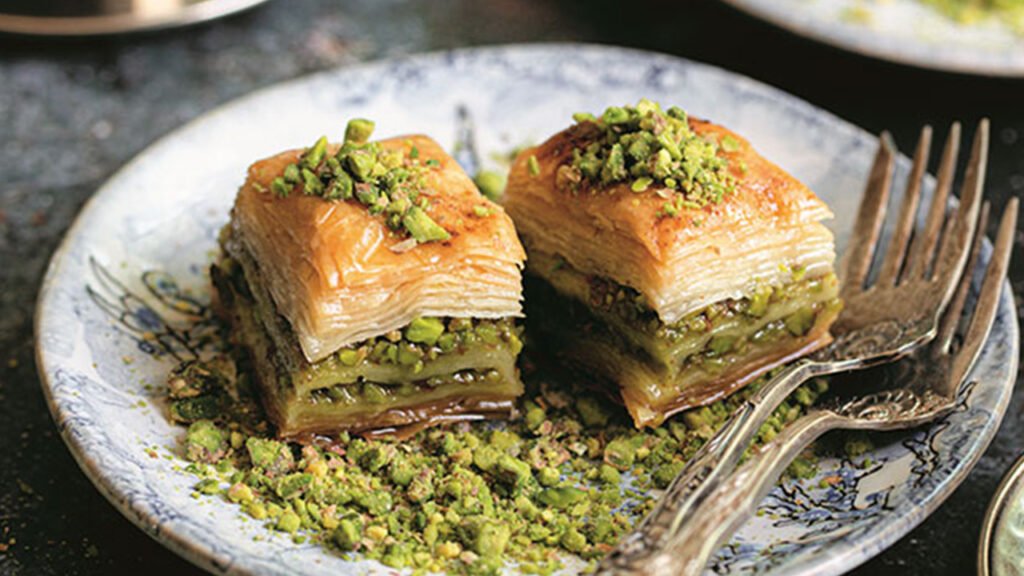
Assorted Premium Baklava — Six Damascus-tradition varieties in one elegantly presented box: Pistachio, Walnut, Cashew, Cream, Finger, and Bird’s Nest. The most comprehensive single baklava vs kunafa Malaysia baklava decision available — for gifting, for personal exploration, and for sharing the full scope of the Damascus tradition.
Baklava Cream — Warbat — Ultra-thin phyllo of extraordinary delicacy filled with silky smooth cream. The most refined baklava expression in the baklava vs kunafa Malaysia collection — the personal revelation for every discerning recipient.
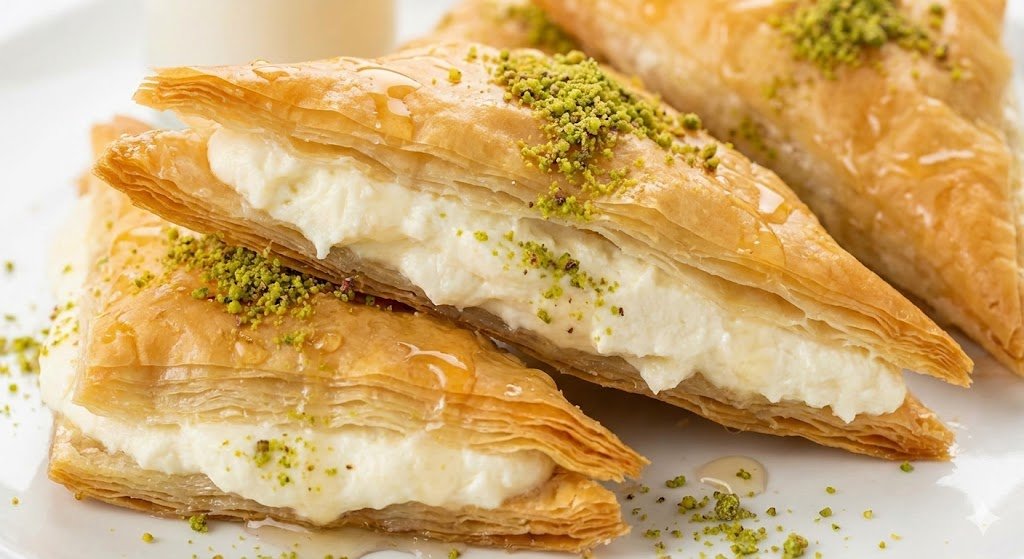
Walnut Baklava — Deep, complex flavour alongside the exceptional omega-3 fatty acid and polyphenol antioxidant profile of genuine walnuts, proven by Medical News Today to support brain health, reduce inflammation, and promote cardiovascular wellness.
The Kunafa Side of the Baklava vs Kunafa Malaysia Decision:
Cheese Kunafa — The definitive kunafa side of the baklava vs kunafa Malaysia decision. Golden kataifi crust, stretchy Halal-certified mozzarella, natural blossom syrup, crushed Aleppo pistachios. TasteAtlas ranked the Levantine cheese pastry tradition as producing the best dessert in the world for 2026. Reheat at 180°C in an air fryer for 4 to 5 minutes. The cheese pull at first service is the most dramatic and most photographed Arabic dessert moment in any Malaysian gathering.
The Both Answer:
Damas Sweets Combined Order — Order both and resolve the baklava vs kunafa Malaysia decision the only way that satisfies both sides of the debate simultaneously. Baklava for the gift boxes and take-home portions; kunafa for the gather-and-serve centrepiece. The complete Damas Sweets Arabic sweets Malaysia experience — Damascus and Nablus traditions in one delivery.
Baklava vs Kunafa Malaysia: Storage and Serving Guide
Baklava Storage and Serving:
Room temperature only in an airtight container away from sunlight and heat — never refrigerate. Cold solidifies the pure ghee within the phyllo layers and permanently destroys the crunch that defines the best baklava in KL experience. Full quality maintained for up to 30 days. Best paired with Arabic coffee, cardamom tea, or warm milk.
Kunafa Storage and Serving:
Consume within 3 days. Refrigerate if not serving immediately. Reheat at exactly 180°C in an air fryer for 4 to 5 minutes — this restores the kataifi crispness and returns the mozzarella to its stretchy, gooey, serve-immediately state. Never microwave — microwave heating produces a soft, rubbery texture that eliminates the crispy exterior that defines authentic kunafa. Serve immediately after reheating for the full cheese pull experience.
Nationwide Delivery: Baklava vs Kunafa Malaysia to Every Address
Damas Sweets delivers both sides of the baklava vs kunafa Malaysia decision to every address in all 13 Malaysian states — with the same production standards, Halal certification, and packaging quality on every order.
Klang Valley: Same-day delivery for orders placed before noon — baklava and kunafa both available.
All Peninsular States: 2 to 4 working days with full live tracking.
East Malaysia — Sabah and Sarawak: Dedicated packaging for extended transit. Baklava arrives in perfect condition. Kunafa is packaged for refrigerated transit with reheating instructions included.
Order at damassweets.com/menu or on Foodpanda — Damas Sweets. Credit card, FPX, and all major Malaysian e-wallets accepted.
What Malaysian Buyers Say About the Baklava vs Kunafa Malaysia Decision
“I ordered baklava first and was completely convinced by the first box that this was something unlike anything I had found in Malaysia. Then I tried the Cheese Kunafa. The cheese pull at my family gathering stopped every conversation in the room. I have never been asked ‘where did you get this?’ so many times about a single food. The baklava vs kunafa Malaysia answer for me is both — always both.”
— Puan Rohani, Petaling Jaya ⭐⭐⭐⭐⭐
“I am Syrian. The baklava vs kunafa Malaysia question has a clear answer for me: Damas Sweets is correct on both sides. The pistachio colour in the baklava is the same as Damascus. The cheese stretch in the kunafa is the same as what I grew up with in Sham. I did not expect to find either standard in Malaysia. I find both here.”
— Khaled Al-Masri, Ampang ⭐⭐⭐⭐⭐
“Our company ordered baklava boxes for Raya gifting and kunafa for our office celebration on the same day. The baklava was gifted to 200 clients — 14 called personally. The kunafa was served at our office Eid lunch — every single colleague asked for the supplier immediately. The baklava vs kunafa Malaysia decision resulted in both becoming permanent office standards.”
— Puan Norzahra, HR Director, Shah Alam ⭐⭐⭐⭐⭐
FAQ: Baklava vs Kunafa Malaysia
What is the main difference between baklava and kunafa in Malaysia?
In the baklava vs kunafa Malaysia comparison, baklava is a cold, crispy, nut-filled layered pastry served at room temperature — perfect for gifting and storing. Kunafa is a warm, soft, cheese-filled shredded pastry served immediately after reheating — perfect for gatherings and sharing. Both are 100% Halal certified at Damas Sweets and produced from Old Damascus and Levantine recipes with imported Aleppo pistachios.
Which is sweeter — baklava or kunafa in Malaysia?
In the baklava vs kunafa Malaysia comparison, both use natural blossom syrup — but baklava typically tastes sweeter because the syrup is applied to a dry, crispy product that absorbs it evenly. Kunafa has a savoury-sweet balance from the mozzarella cheese filling, which provides a mild counterpoint to the syrup, making the overall flavour less intensely sweet and more complex.
Can I order baklava and kunafa Malaysia together in one delivery?
Yes — Damas Sweets delivers baklava and kunafa Malaysia together in a single order at damassweets.com/menu with same-day Klang Valley delivery for orders before noon.
Is kunafa Malaysia better than baklava for Raya gifting?
In the baklava vs kunafa Malaysia Raya gifting decision, baklava is the stronger choice because it travels without refrigeration, stores for 30 days, and delivers its full experience at room temperature without any preparation by the recipient. Kunafa is the stronger choice for Raya gatherings and serve-at-table occasions. Order both for complete coverage of every Raya occasion.
Baklava vs Kunafa Malaysia: The Final Answer
Baklava vs kunafa Malaysia is not a competition with a winner — it is a comparison of two extraordinary Levantine traditions that serve different sensory purposes, different occasions, and different recipient experiences with equal perfection.
Baklava is cold, crispy, structured, and giftable — the Old Damascus pistachio and ghee tradition perfected across a thousand years, available from Damas Sweets at its authentic standard for every gift, every Raya box, and every occasion where the dessert travels to the recipient. Kunafa is warm, soft, soulful, and shareable — the Levantine cheese and kataifi tradition brought to Malaysia at its authentic standard, the centrepiece dessert for every gathering, every Ramadan iftaar, and every occasion where the dessert is served rather than gifted.
The baklava vs kunafa Malaysia answer is not either/or. It is both — from the only producer in Malaysia that delivers both at the Old Damascus and Levantine standard, entirely in-house, with imported Aleppo pistachios, 100% pure ghee, daily fresh production, and 212+ verified reviews confirming that standard on every single order.
Also on Foodpanda — Damas Sweets | 212+ Verified Reviews | 100% Halal Certified | Same-Day Delivery Klang Valley | All 13 Malaysian States